
Paperini, E., Demarchi, B., Dubbini, N., Gattiglia, G., Yeomans, L., & Sciuto, C. (2026). Artificial intelligence in zooarchaeology: Convolutional neural networks to classify duck bones. Journal of Archaeological Science, 191, 106608.
https://doi.org/10.1016/j.jas.2026.106608
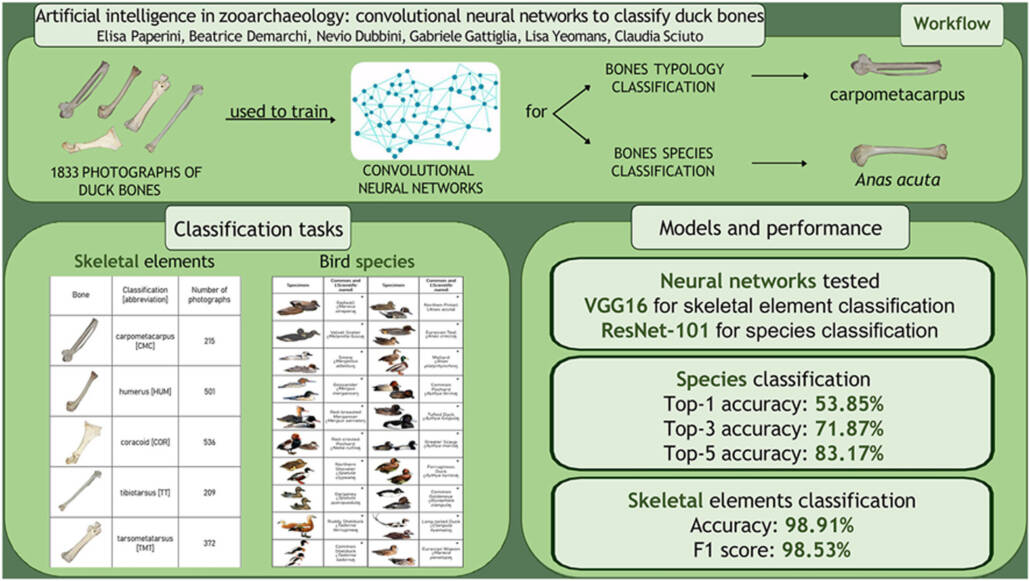
In the last decade, the use of neural networks has accelerated the integration of Artificial Intelligence (AI) systems into archaeology. These systems assist archaeologists in fundamental yet time-consuming tasks, such as cataloguing and identifying artefacts. This study focuses on the application of Convolutional Neural Networks as a proof of concept for the systematic cataloguing of avifauna osteological remains, an especially challenging task in archaeozoology, due to the lack of systematic reference collections, morphological similarity and high taxonomic diversity of species. Differentiating species of duck is important because they exhibit diverse and highly specialised habitat requirements, which allow detailed palaeoenvironmental reconstructions. Furthermore, tracking changes in migration patterns over time provides insights into climatic and anthropogenic impacts on bird behaviour and ecology. Two neural networks were developed: the first designed to classify five types of skeletal elements to the species level and the second aimed at cataloguing 20 duck species (Anatinae, Aythyinae, Tadorninae, and Oxyurini) according to their skeletal elements. The CNNs developed in this study were trained on 1833 photographs, achieving 98% top-1 and 72% top-3 accuracy for the classification of element type and species, respectively. Overall, this work demonstrated that, even for especially challenging tasks, the integration of AI in archaeozoology expedites cataloguing processes.
Parmaksız, R., Demarchi, B. & Yeomans, L. (2026) Birds Through Time in Türkiye: Morphological and Proteomic Approaches to Archaeological Avifauna. Turkish Journal of Archaeological Sciences. 6, 24-41.
https://en.arkeolojibilimleridergisi.org/tjas-6-parmaksiz-et-al
Türkiye has sustained a dynamic ecosystem from prehistory to the present, characterized by its rich biogeography and natural resources. Birds, one of the most active components of this ecosystem, have always maintained a close relationship with human communities and are currently represented by more than 500 species in Türkiye. When examined in an archaeological context, birds play a significant role in understanding past environments and climates; the cultural and symbolic life of prehistoric humans and human-environment entanglement. In this study, 97 zooarchaeological studies conducted at 94 archaeological sites across Türkiye were compiled and subjected to meta-data analysis to assess the extent to which birds have been studied in archaeological contexts.
Our study shows that, despite the recent increase in zooarchaeological research in Türkiye, there are still significant gaps in the study of birds. After identifying the possible reasons for these gaps, we offer several research suggestions. The key suggestions for enabling high-quality analyses of bird eggs and bones —which are crucial for understanding past environmental conditions, seasonality, and early bird management— include: establishing a comprehensive ornithoarchaeological reference collection in Türkiye, training specialists interested in archaeological bird remains, and employing ancient protein analyses (paleoproteomics), which allow the identification of highly fragmented remains with high success rates. Additionally, within the scope of this study, recent rapid developments in paleoproteomics are briefly reviewed, and the methods are introduced.

Codlin, M.C., Yeomans, L., Stiller, J. et al. A library of avian proteins improves palaeoproteomic taxonomic identification and reveals widespread intraspecies variability. Nat Commun 16, 8820 (2025).
https://doi.org/10.1038/s41467-025-63886-1

Biomolecules offer unparalleled insights into ancient life, from evolutionary pathways of organisms to the health and cultural practices of our ancestors. Biomineral-associated proteins, such as those found in bone, teeth, and eggshell, have become instrumental for studying ancient life, as they often endure post-mortem degradation far longer than DNA. Harnessing advancements in avian genomics, we annotate bone and eggshell protein sequences for 112 Anatidae (ducks, geese and swans) species, a biologically complex group of birds that are also central to many archaeological and ecological questions.
While palaeoproteomics (the study of ancient proteins by mass spectrometry) conventionally assumes that protein sequences vary only at the species level or above, our research demonstrates widespread evidence for single amino acid polymorphisms (SAPs) occurring within-species.
Yeomans, L. Zooarchaeology of Managed, Captive, Tame, and Domestic Birds: Shifts in Human–Avian Relationships. J Archaeol Res (2025).
https://doi.org/10.1007/s10814-024-09206-5

In this paper, the author reviews archaeological evidence for shifting human–avian interactions. Many species of birds, altering their behavior in response to anthropogenic niche construction, experienced an increased encounter rate with humans. Intensification of this relationship led to management and domestication of some taxa.
An examination of the methods zooarchaeologists employ to study this changing interaction illustrates the limitations of evidence. Art history, architecture, historical sources, evidence based on modern distributions, and DNA analysis fill in some gaps in our knowledge. It is necessary to develop novel methods to investigate the earlier history of bird–human interactions.